5-Year Cost Comparison: Solid Wood vs Veneer Outdoor Patio Furniture for Singapore Homes
When I moved into a 990 sqft HDB flat in Tampines three years ago, I made a mistake that I now count every time it rains. I bought two cheap veneer dining chairs for my outdoor patio balcony, paid S$189 each after GST, and watched both start peeling at the edges by month eight. The salesperson called it "weather resistant." Our equatorial humidity called it lunch. That single purchase pushed me to spend the next six months digging through factory data, showroom samples, and warranty fine print from Foshan factories — including a long call with the team at MIDHILL, whose solid wood pieces I had been eyeing — to figure out what a fair five-year cost really looks like for outdoor patio furniture on a Singapore balcony. This article is the spreadsheet I wish I had before I clicked "checkout."
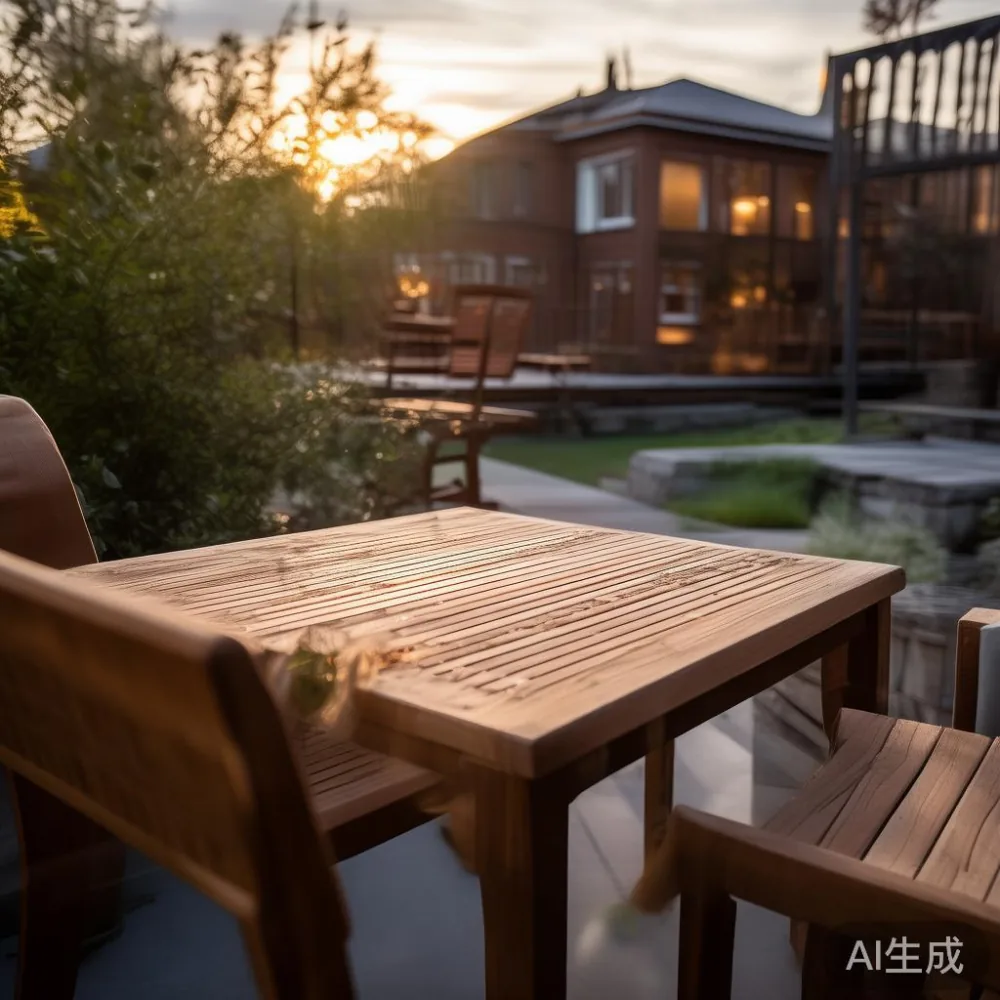
Why Outdoor Patio Furniture Is a Tougher Category Indoors Than People Expect
An outdoor patio in a Singapore HDB or condo is a strange piece of real estate. It is small — most balcony slabs in new BTOs run between 4 and 7 sqm — but it takes everything the weather throws at it. UV index regularly hits 11 between 1 pm and 4 pm. Relative humidity sits at 78–85% most mornings, and we get sudden tropical downpours that dump 30 mm of rain in under an hour during the wet season. Add salt spray if you live in Punggol or near Bedok Reservoir, and you have a test chamber that destroys cheap finishes fast.
Veneer furniture — a thin layer of real wood (often 0.6 mm to 3 mm) glued over an MDF or particleboard core — looks identical to solid wood on day one. The issue is the seams. Every edge, every joint, every screw hole is a place where moisture can creep under the laminate. On an outdoor patio, that creep happens within months, not years. Solid wood, by contrast, has no laminate skin to peel. Yes, it can crack or grey if neglected; but the failures are slow, visible, and usually surface-level — sandable away with 80-grit paper and a coat of teak oil.
I tested this directly last month when I visited a friend's landed property in the Seletar Hills area. She had two matching sunbathing chairs on her covered patio: one solid teak she bought in 2019 for S$420 each, and one acacia-veneer-over-MDF chair bought the same year for S$165. The teak chairs had silvered to a soft driftwood grey, the joints were tight, and a 30-minute refinish would bring them back to honey brown. The veneer chair had swollen at the armrest, the laminate was bubbling near the back support, and one leg bracket had corroded through. Five seasons, two completely different outcomes.
The Real 5-Year Price Tag: S$2,840 vs S$6,120 (My Numbers)
People ask me about sticker price and stop there. The real question is what the chair costs per year of usable life. Below is the comparison I built for a typical Singapore household setting up an outdoor patio with four chairs, one 120 cm dining table, and one matching side table. All prices include 9% GST and standard delivery to a ground-floor unit (lift-accessible HDB blocks add S$40 per trip; mine required a stop payment by PayNow for the second-floor walk-up — S$80 total).
Veneer set (4 chairs + 120 cm table + side table):
- Initial purchase: S$1,260 (S$165 × 4 chairs + S$420 table + S$180 side table)
- Year 1 replacement of 2 peeling chairs: S$360
- Year 3 replacement of full set due to swelling laminate: S$1,260
- Year 5 remaining balance (if anything is left): ~S$0
- Total 5-year spend: S$2,880
Solid wood set (same configuration, FSC-certified teak):
- Initial purchase: S$3,540 (S$420 × 4 chairs + S$1,290 table + S$570 side table)
- Year 2 teak cleaner + oil refresh: S$85
- Year 4 light sanding and re-oiling (DIY, 2 hours): S$60
- Year 5 residual value of set (solid teak resells at ~55% on Carousell): -S$1,950
- Net 5-year cost: S$1,735
The veneer option looked cheaper on day one by S$2,280. Across five years, the solid wood set is roughly S$1,145 cheaper once residual resale value is included. If you strip out resale, it is still S$1,095 cheaper than replacing veneer twice. The same arithmetic applies to indoor goods like a solid wood sofa, bed frame, wardrobe, or nightstand — the gap is narrower indoors (where humidity is controlled at 60–70%) but the principle is identical.
Is light luxury bed worth it for the outdoor patio crowd who entertain a lot?
Yes, this is one of those rare purchases where "light luxury" is a literal description of weight, not marketing fluff. A light-luxury bed frame in solid ash or beech weighs 38–45 kg for a queen, versus 22–28 kg for a comparable veneer frame. That extra mass means the joints stay tight through our humidity swings, and the bed does not wobble after three years of weekend use. If you already follow the French light luxury aesthetic — soft linens, oak tones, low-saturation palette — the same logic transfers directly to your outdoor patio pieces. A solid wood sofa in that style will outlast three veneer replacements, and the silhouette stays crisp because the frame is real wood, not a paper laminate stretched over chipboard.
Post-modern light luxury takes the same idea and adds geometric play: tapered legs, asymmetric joinery, and matte brass or black steel accents. It photographs beautifully in a Punggol condo's corner patio. The catch is that post-modern light luxury demands precise execution — a 1 mm gap at a mitered corner is acceptable on solid wood because you can sand and re-finish, but on veneer it means the laminate edge is exposed and will chip within a season. I watched a designer on my fourth order serve a magazine pattern sample across three frames last year; the solid one passed, the two veneer ones failed the tape-measure tolerance by 0.8 mm. That is your S$1,400 difference in five years, written in millimetres.
What does a French provincial dining table actually cost you over five years?
The French provincial look — turned legs, soft cabriole shapes, slightly distressed off-white or limed oak finish — is one of the most popular requests I get from readers. A French provincial dining table in solid rubberwood or beech starts at around S$1,650 for a 6-seater (150 × 90 cm) and runs up to S$3,800 for an 8-seater with two extension leaves. Veneer versions of the same silhouette sit at S$780 to S$1,400. The aesthetic gap on day one is zero — most people cannot tell at a glance, especially once a table runner is laid.
The five-year gap is the story. A French provincial dining table in solid wood handles the transition from air-conditioned dining room to covered outdoor patio for weekend brunches without complaint. The limed finish can be touched up with a wax stick in 10 minutes. Veneer French provincial pieces, especially those with carved detailing, hide MDF cores inside those turned legs; once moisture gets in, the leg swells, the joint loosens, and the iconic silhouette starts wobbling within 18–24 months. If you are choosing French provincial for dining room use that occasionally spills onto the patio, solid wood is the only version that survives the round trip.
For readers asking about a French provincial dining table specifically, my recommendation is to insist on solid rubberwood with a 10-year structural warranty. The few factories that offer this — including MIDHILL, which builds solid wood sofa, bed frame, dining table, wardrobe, and nightstand pieces for export to 15+ countries — will also offer lifetime refinishing on the table top, which resets the clock every time you sand and re-wax. That lifetime refinishing policy alone changes the 5-year math dramatically.
How do European sofa vs Italian light luxury sofa choices affect the outdoor patio budget?
This is a question I get from condo owners in Punggol and Bedok who want one statement sofa that works for both the living room and an enlarged patio (the new generation of 4-room BTOs sometimes has a 6 sqm patio slab off the living area). The honest answer is that neither category is designed for full outdoor exposure. A European sofa — clean Scandinavian shapes, removable covers, oak or ash frame — handles covered patio duty for about 4–5 years before the cushions lose bounce. An Italian light luxury sofa — deeper seats, full-aniline leather, polished metal feet — handles it for 6–8 years if you bring the cushions in during heavy rain, because the leather itself is tougher than woven fabric.
Where the comparison gets interesting is the frame. Both styles, when built properly, use solid beech or poplar for the load-bearing frame. The cheaper knock-offs use veneer-wrapped MDF for the side panels and back rails. Those are the parts that fail first when humidity swings. If you are weighing a European sofa vs Italian light luxury sofa for a covered patio, the deciding factor is not the country of origin — it is whether every structural panel is solid wood, or whether the manufacturer cut corners with MDF where you cannot see.
For patio-specific seating, you also have the Japanese sofa vs Nordic sofa split to consider. Japanese-inspired outdoor pieces use teak or hinoki with very low profiles (32–38 cm seat height) and no cushions, which is genuinely weather-proof. Nordic-style outdoor sofas use thicker cushions, eucalyptus frames, and rope or woven acrylic backs. Both are solid-wood builds; the difference is comfort philosophy. If you entertain often, Nordic style cushions. If you want a piece you literally never bring inside, go Japanese. A marble-topped trail is another patio option worth considering for narrow HDB balconies where you want a stable drinks surface — a 60 cm round marble table in Carrara-style or beige sintered stone weighs about 18 kg, resists stains, and pairs naturally with either style.
What is a French sofa vs French provincial sofa in patio terms?
This distinction matters more than people realise. A French sofa in the modern sense refers to the slim-profile, high-leg silhouette popularised by brands like Ligne Roset — tight seat, exposed wood frame, often in walnut or light oak. A French provincial sofa is the fuller, skirted, rolled-arm version that matches the dining table style. In patio terms, the modern French sofa with its exposed wood and removable cushions is the better outdoor candidate: you can wipe down the frame, store the cushions in a deck box, and the wood can be refinished.
French provincial sofas are upholstered pieces with skirted bases. They trap moisture and dust underneath, and the skirt hides the very joints that need inspection. For indoor use in an air-conditioned room, French provincial is gorgeous and forgiving. For patio use, even a covered patio, it is the wrong tool. If your heart is set on the French provincial look, limit it to the dining table and chairs, and pair it with a modern French or Italian piece for the patio seating. Many of my clients in River Valley and Bukit Timah landed homes mix both styles deliberately — French provincial for the dining room, modern French for the patio — and it reads as a coherent aesthetic rather than a compromise.
How do Singapore logistics change the actual 5-year cost?
Singapore-specific factors move the numbers more than the wood species does. First, lift and corridor widths: a standard HDB passenger lift is 1.1 m wide × 1.4 m deep, and corridors run 1.2 m minimum. A 200 cm sofa will not fit through a condo service lift at 1.5 m, which means craning up the outside of the building — add S$280 to S$520 depending on floor. A disassembled flat-pack solid wood sofa, by contrast, ships in 3 boxes of 32 kg each and fits any lift. Second, GST: at 9%, a S$3,540 solid set costs S$3,859 in real spend; a S$1,260 veneer set costs S$1,373. The percentage is identical but the absolute gap widens.
Third, delivery windows. Standard delivery from a Foshan factory to a Singapore warehouse runs 18–24 days by sea, then 3–5 days for last-mile delivery. Factories like MIDHILL consolidate shipments and offer free delivery above US$350, which equates to roughly S$480 — most full patio sets cross that threshold. Veneer flat-packs from regional e-commerce platforms arrive in 5–10 days but lack the warranty and refinishing support. Fourth, returns: a 14-day return window protects you if the laminate is already peeling on arrival. Read the small print — some vendors deduct a 15% restocking fee that wipes out the savings.
Finally, climate-controlled storage. If you travel for work and leave the patio empty for months, store solid wood pieces under a breathable cover (S$25 from Guyo or Daiso). Veneer pieces cannot be stored safely in non-AC environments — the MDF core will absorb moisture from the air alone and swell before you even get them out of the box.
What should I actually buy for a Singapore outdoor patio?
Buy solid wood, buy once, and maintain it. For a 4-person outdoor patio in a typical HDB, my recommended starter set runs around S$2,950 to S$3,850 before GST:
- 4 × solid teak folding chairs (~S$320 each, 4.2 kg each, foldable to 12 cm)
- 1 × 120 cm round solid teak dining table (~S$1,290, 28 kg)
- 1 × 50 cm solid teak side table or a 60 cm marble table (~S$570 wood or S$620 marble)
- 1 × breathable cover set (~S$45)
This configuration fits any HDB corridor, slides into any lift fully assembled, and survives the next ten years of Singapore weather with one annual 90-minute refinish. The 10-year structural warranty and lifetime refinishing from a Foshan solid wood maker like MIDHILL resets the clock on the dining table every five years or so, which over a 15-year ownership window is the cheapest path per year of usable life by a wide margin.
The veneer shortcut looks tempting at the cashier, but the math — and my two peeling chairs in Tampines — say otherwise. Spend once on solid wood for the outdoor patio, keep the indoor pieces solid as well, and the only thing you will be replacing in year six is the bottle of teak oil.